
Deconstruct
Today we're going to learn Chinese by .. learning Icelandic words???
What can the Icelandic language, supposedly another difficult language to master, offer us that is useful for learning Chinese?
We saw in the earlier post that Chinese words & nouns can be formed by combining simpler building units. For example, 火山 huǒ shān (volcano) = 火 (fire) + 山 (mountain). At the individual word level, 从 cóng (follow or obey) = 1 人 following behind another 人. I was lucky to come across this compilation of Icelandic words which demonstrate the same concept. Here, the compound words are broken down into the constituent units. The way how the units fit together seems straightforward in some examples but they can also be quirky or imaginative in other instances. In any case, they provide perfect illustration of how we can form up / break down words and recognise the underlying ideas & meanings.

Top & Bottom: Breaking down Icelandic compound words into units. Somewhat imaginative, somewhat funny.
Skeleton is a frame made of bone, while love makes you feel like a (willingly captured) prisoner.
All images from boredpanda.com

Taking the same approach, I’m going to take Chinese words apart, breaking them down into separate parts to help reveal the meaning. For a start, we’ll look at 4 “top-&-bottom” words.
1. When you are neither up nor down

卡 kǎ means to be stuck or choked. Its top part is actually the word 上 shàng (up) while the bottom part is 下 xià (down). In other words, when you are neither up nor down, yes, you are effectively stuck.
And if you need some help remembering this, let me introduce this earworm (incidentally, as this is one of my boy's favourite songs, it gets played so many times in the house that it is my earworm as well).
Lyrics:
Oh, the grand old Duke of York, He had ten thousand men; He marched them up to the top of the hill, And he marched them down again. And when they were up, they were up, And when they were down, they were down, And when they were only half way up, They were neither up nor down.
(don't blame me if you can't get the song out of your head in the next couple of hours #peace)
PS: in another context, 卡 kǎ can also mean card, as in Christmas card or EZ-Link card. In this case, it is acting as a loanword (the pinyin "kǎ" sounding very close to "card"). Refresh your memory on loanwords explained earlier.
2. A small tip (sticking out of a large base)
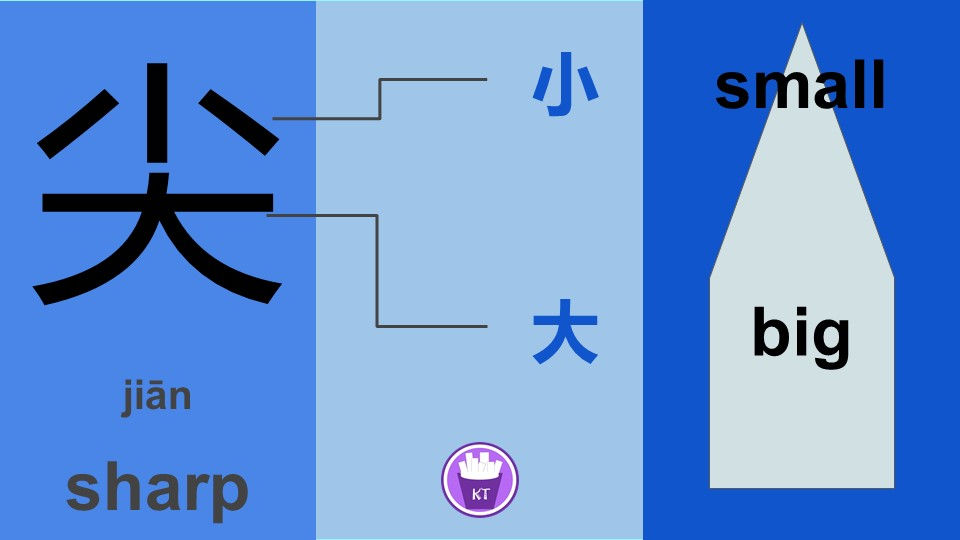
尖 jiān refers to a sharp edge or tip. The component on the top is 小 xiǎo (small) while the bottom one is 大 dà (big). Imagine a large relatively flat base and then you have one small sharp tip sticking out on 1 side. That's the visual imagery for "sharpness".
3. Small earth = dust

Continuing with another word that has 小 xiǎo (small) on top.. this time round, the bottom unit is 土tǔ (earth). Small + earth = dust. Simple right? Remember this when you come across the word 尘 chén.
4. A crook

歪 wāi can be separated into 不 bù (no) and 正 zhèng (straight). Hence it literally means to be not straight i.e. bent or crooked. Figuratively it can refer to a devious or underhand person / method.
Hope you enjoy breaking down these words and unveiling meaning from their units. Look out for more in subsequent posts (tag: Deconstruct).
Feeling the satisfaction from deconstructing things? Here's something to reward that inner OCD soul ..

Deconstruction to reveal new patterns & meanings. Images from Pinterest
Comments